
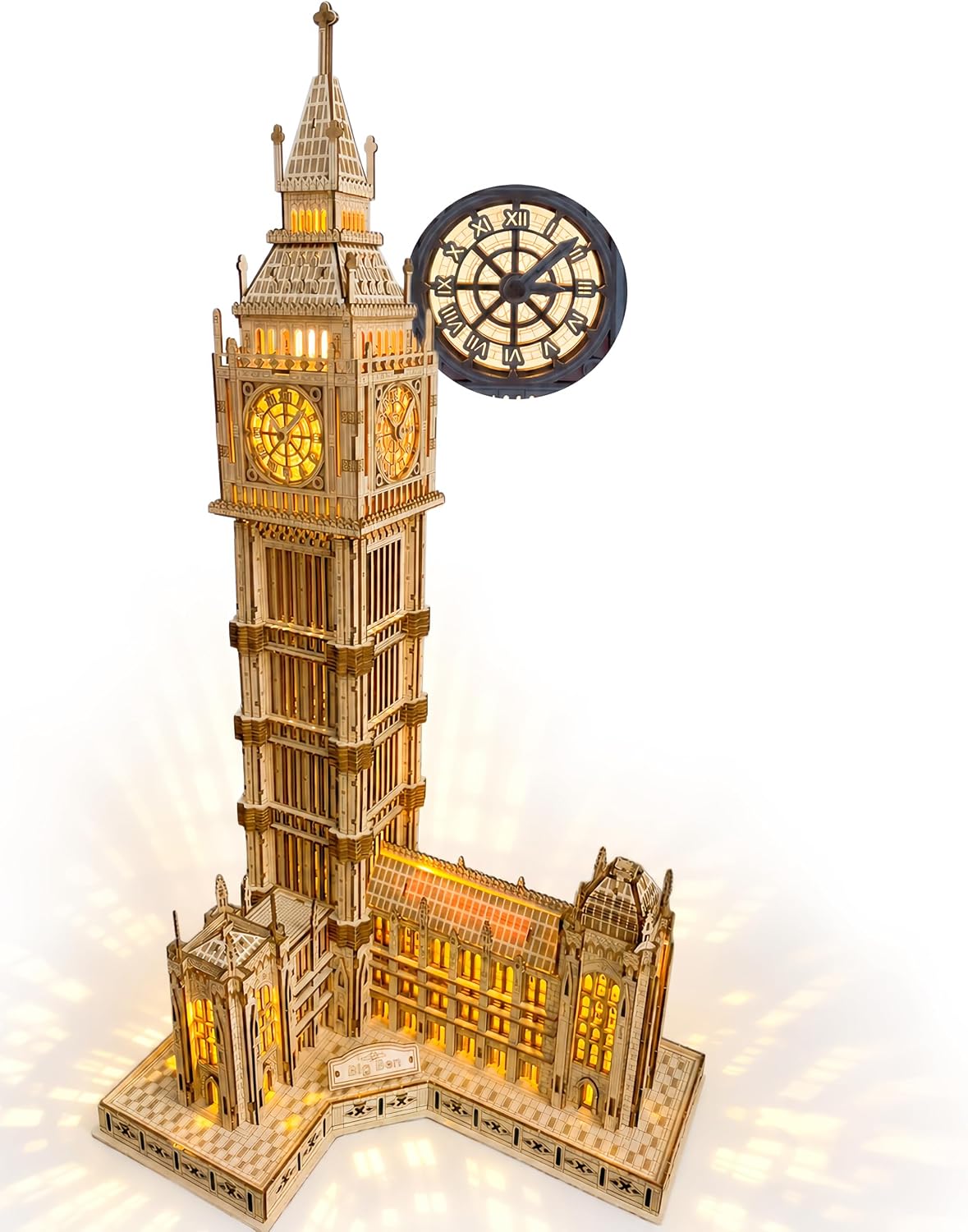
A jigsaw puzzle creates a flat image by matching shapes, colors and patterns. A 3D wooden puzzle creates a freestanding object by connecting structural pieces in a planned sequence. Jigsaws focus on visual sorting across one surface; 3D wooden puzzles add orientation, construction and sometimes lighting or movement.
Neither format is universally better. The right choice depends on whether you want to reconstruct an image or build an object that can remain on display.
What is the main difference between a 3D wooden puzzle and a jigsaw puzzle?
Traditional jigsaw pieces usually lie flat and can be assembled in many parallel areas. Builders may complete the border, sort colors and work on separate sections before joining them.
A 3D wooden puzzle usually follows a more ordered process. One floor, wall, axle or architectural layer supports the next. Tabs and slots must face the correct direction, and the model may need to be rotated as it grows.
| Feature | 3D wooden puzzle | Traditional jigsaw puzzle |
|---|---|---|
| Finished form | Freestanding model | Flat image |
| Main skill | Spatial assembly and sequence | Shape, color and pattern matching |
| Build order | Often guided by numbered steps | Usually flexible |
| Workspace | Needs room around a growing object | Needs a flat surface matching the final image size |
| Special features | May include LEDs or movement | Usually visual only |
| After completion | Display object or interactive model | Display flat, frame or disassemble |
| Correction | May require reversing a fitted joint | A wrong piece usually remains visibly unmatched |
Which type is harder?
Difficulty depends more on the specific design than the category. A large jigsaw with repeated colors may demand long visual searches. A 3D wooden model with small parts, similar-looking panels, wiring or gears may demand careful orientation and sequence.
Piece count is not directly comparable. A 300-piece wooden model and a 300-piece jigsaw do not represent the same amount or kind of work. In a wooden model, one piece may be a large wall while another is a tiny railing. In a jigsaw, most pieces contribute a similar area to the final image.
For wooden models, compare piece size, instructions, lighting, moving parts and structural layers. The 3D wooden puzzle difficulty guide explains these factors in more detail.
Which puzzle is better for beginners?
A familiar jigsaw may have the easier first five minutes because the task is immediately recognizable: find edges and match the picture. A beginner can still complete a 3D wooden puzzle successfully by choosing a clear subject and following the manual in order.
Miniature houses offer visible milestones such as a floor, walls and roof. The 198-piece Winter Cabin and 187-piece Hawaiian Beach House let a new builder see a recognizable structure develop.
A beginner should choose the finished result they care about most. Motivation matters when a project spans several hours.
How does the building experience feel different?
A jigsaw often encourages scanning and sorting. The repeated loop is visual: search, compare and test. More than one person can work on separate parts of the image at the same time.
A 3D wooden puzzle often feels closer to model building. The loop is structural: identify, orient, connect and confirm. Progress changes the model's shape, and later steps reveal why earlier tabs, braces or openings were placed in a particular way.
Mechanical models add another layer. The Paddle Steamer uses a manual axle to move its paddle wheels. Illuminated architecture such as the Big Ben Clock Tower combines assembly with a finished lighting effect.
Which puzzle needs more space?
A jigsaw needs a flat area at least as large as the completed image, plus room for loose pieces. That area may remain occupied throughout the project unless a puzzle board is used.
A 3D model can begin in a smaller footprint, but it needs clear space around and above the growing structure. Tall architecture requires vertical clearance. Wide scenery and miniature houses need enough shelf depth after completion.
Before choosing, compare both the building surface and the permanent display location. The display and care guide explains how sunlight, dust and humidity affect a finished wooden model.
Which one makes a better display piece?
Choose a jigsaw when the artwork itself is the main attraction and you want a framed, flat result. Choose a 3D wooden puzzle when you want visible depth, changing shadows and details that can be viewed from several angles.
LED wooden houses create a second display experience after dark. Mechanical kits invite occasional interaction. Wooden sculpture puzzles, such as the Walnut and Teak Soccer Ball, emphasize material and geometric form.
The better display is the one that fits the room and the owner's interests. A model should have enough space to be seen clearly rather than becoming crowded among unrelated objects.
Can families or couples build both types together?
Yes, but collaboration works differently. A jigsaw naturally allows several people to sort and assemble separate visual regions. A 3D wooden puzzle has a more dependent sequence, so one person may read instructions while another locates pieces, checks orientation or assembles a sub-section when the manual allows it.
For younger builders, follow the product's age guidance and supervise small parts, tools and electrical components as appropriate.
How should you choose between them?
Choose a 3D wooden puzzle if you want:
- a model-building sequence;
- a freestanding result;
- architectural, mechanical or miniature details;
- optional light or movement; and
- an object to keep on a shelf or desk.
Choose a jigsaw puzzle if you want:
- open-ended sorting;
- a flat picture as the goal;
- easy parallel work with several people;
- a broad range of printed artwork; and
- a project that can be disassembled and stored flat.
Explore the Astshun&co 3D wooden puzzle collection to compare illuminated houses, architecture, a mechanical ship and wooden display sculptures.
Frequently asked questions
Is a 3D wooden puzzle the same as a model kit?
The categories overlap. A 3D wooden puzzle uses interlocking pieces and problem-solving, while the finished result is also a model. Product descriptions may use both terms.
Are 3D wooden puzzles reusable?
Some press-fit models can be partly disassembled, but repeated removal may loosen or damage tabs. They are generally designed to become a finished display object rather than a puzzle rebuilt frequently.
Do 3D wooden puzzles take longer than jigsaws?
Not always. Time depends on the specific piece count, part size, pattern, lighting, mechanisms and the builder's pace. Compare the individual projects instead of the category alone.
Which is better for spatial thinking?
A 3D wooden puzzle makes orientation, sequence and structural relationships explicit. A jigsaw emphasizes two-dimensional pattern and shape recognition. Both use observation and problem-solving in different ways.
Can a completed 3D wooden puzzle be framed?
It is normally displayed on a shelf, desk or cabinet because it is freestanding. A shadow box may suit some shallow models, but it must provide adequate depth and access to any lights or moving parts.