
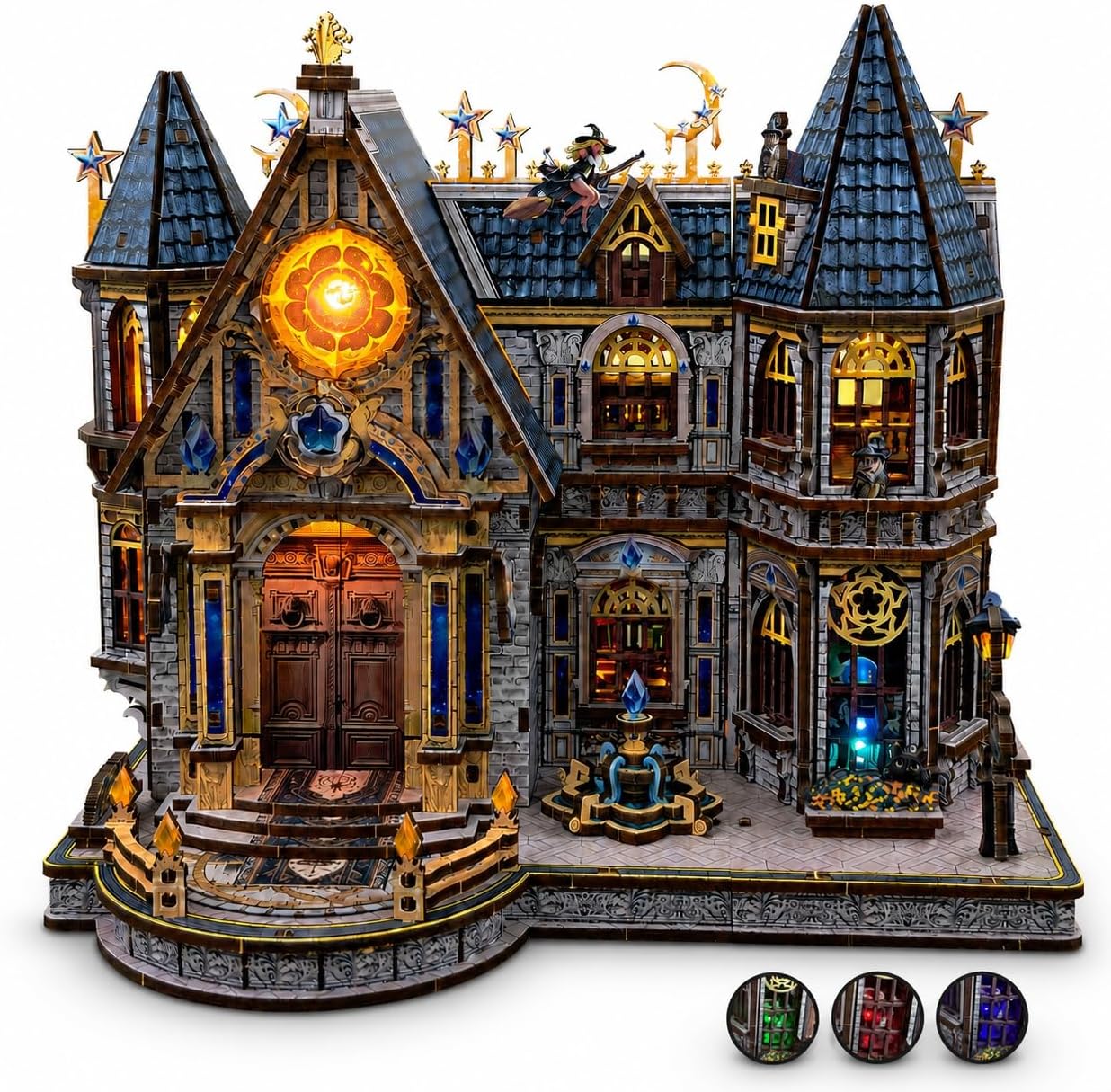
The main benefits of 3D wooden puzzles for adults are focused hands-on time, visible progress, creative problem-solving and a finished object that can remain on display. Unlike a flat puzzle that returns to a box, a wooden model can become a miniature house, landmark, ship or sculpture with a continuing place in the home.
These are hobby benefits rather than medical claims. A wooden puzzle cannot promise to treat stress, improve memory or replace professional care. Its value is more direct: it gives your hands and attention one defined project, away from notifications and endless scrolling.
What are the main benefits of 3D wooden puzzles for adults?
Adults often choose 3D wooden puzzles for five practical reasons:
- Focused attention: each step has a clear purpose and immediate physical feedback.
- Screen-free time: instructions, parts and tools can occupy an evening without another device.
- Visible progress: flat sheets gradually become rooms, towers or working mechanisms.
- Creative ownership: the finished model carries the builder’s time, choices and memories.
- Display value: many models include architectural details, natural wood contrast or lighting.
The experience combines several familiar hobbies. It has the sequence of a model kit, the fit-testing of a puzzle, the material feel of a wood craft and the decorative result of a miniature. That combination helps explain why someone who does not regularly complete jigsaw puzzles may still enjoy a three-dimensional build.
Why does the building process feel rewarding?
A model grows in understandable stages. Completing a base makes the footprint real; adding walls defines the structure; installing a roof or lighting reveals the final character. Those milestones arrive before the entire project is finished, so progress remains visible.
The work also involves small decisions. You check orientation, decide when an edge needs light sanding and plan how to support a section while adding the next part. The instructions set the route, but your care determines how smoothly the pieces come together.
The result feels personal because it records time. A Winter Cabin built over quiet December evenings can recall those evenings later. A Big Ben model may connect with travel, architecture or a person who gave the kit as a gift.
How are 3D wooden puzzles different from screen-based hobbies?
A physical build has natural stopping points. You can finish a numbered section, place unused pieces back in their tray and return later. There is no feed asking for another swipe and no virtual progress that disappears when an application closes.
| 3D wooden puzzle | Screen-based activity |
|---|---|
| Physical parts and tactile feedback | Visual and audio feedback through a device |
| Progress remains visible on the table | Progress is usually stored inside an app |
| Natural pauses between assembly stages | Sessions can continue without a clear endpoint |
| Finished result can become home decor | Result often remains digital |
| Can be built alone or shared at one table | May be solitary or connected remotely |
Screens are useful tools, and builders may still use a video for clarification. The difference is that the main activity happens through the material itself.
Can a finished model be used as home decor?
Yes. Display is one of the defining benefits of a 3D wooden puzzle. Illuminated houses add a warm point of light to a shelf. Architectural models introduce a recognizable vertical shape. Mechanical ships and geometric soccer-ball sculptures work as conversation pieces in an office or hobby room.
Choose the future display location before purchasing. Check the completed dimensions, nearby power access for USB or battery lighting, shelf depth and exposure to direct sunlight. A model that fits its intended space is more likely to remain part of the room.
Dust gently with a soft brush and keep untreated wood away from persistent humidity. Our display and care guide covers lighting, dust and storage in more detail.
How to choose a project that you will enjoy
Start with the finished object, then work backward to the building experience. Ask which model you would want to see every day and how much time you want to give the project.
- Subject: miniature houses, landmarks, vehicles, fantasy scenes or sports sculpture.
- Time: a shorter weekend kit or a detailed multi-session project.
- Interaction: stationary display, opening sections, LED lighting or mechanical movement.
- Space: both the work area during assembly and the shelf area afterward.
- Experience: straightforward construction for a first kit or denser detail for a longer challenge.
A kit should be challenging enough to hold attention without turning every step into a struggle. New builders can use our guide to the best 3D wooden puzzles for beginners. Experienced builders can browse all Astshun&co 3D wooden puzzles by model style.
Frequently asked questions
Are 3D wooden puzzles good for adults?
Yes. They combine structured assembly, visual problem-solving and craft-like work, then leave the builder with a model suitable for display. Choose the piece count and mechanism complexity to match the person’s experience.
Are 3D wooden puzzles relaxing?
Many people find slow, focused building enjoyable because it gives attention one concrete task. Individual experiences vary, and a hobby should not be presented as medical treatment.
Do 3D wooden puzzles improve the brain?
Building uses observation, sequencing, spatial reasoning and fine hand movements. It is fair to describe those actions, but a commercial puzzle should not promise clinical cognitive improvement.
Are wooden model kits a good screen-free hobby?
Yes. The core activity uses physical parts and printed instructions, and the project has clear stages that make it easy to pause and resume.
What happens after a 3D wooden puzzle is finished?
The completed model can be displayed on a shelf, desk or cabinet. Illuminated and mechanical models also retain a functional feature that can be demonstrated after assembly.