
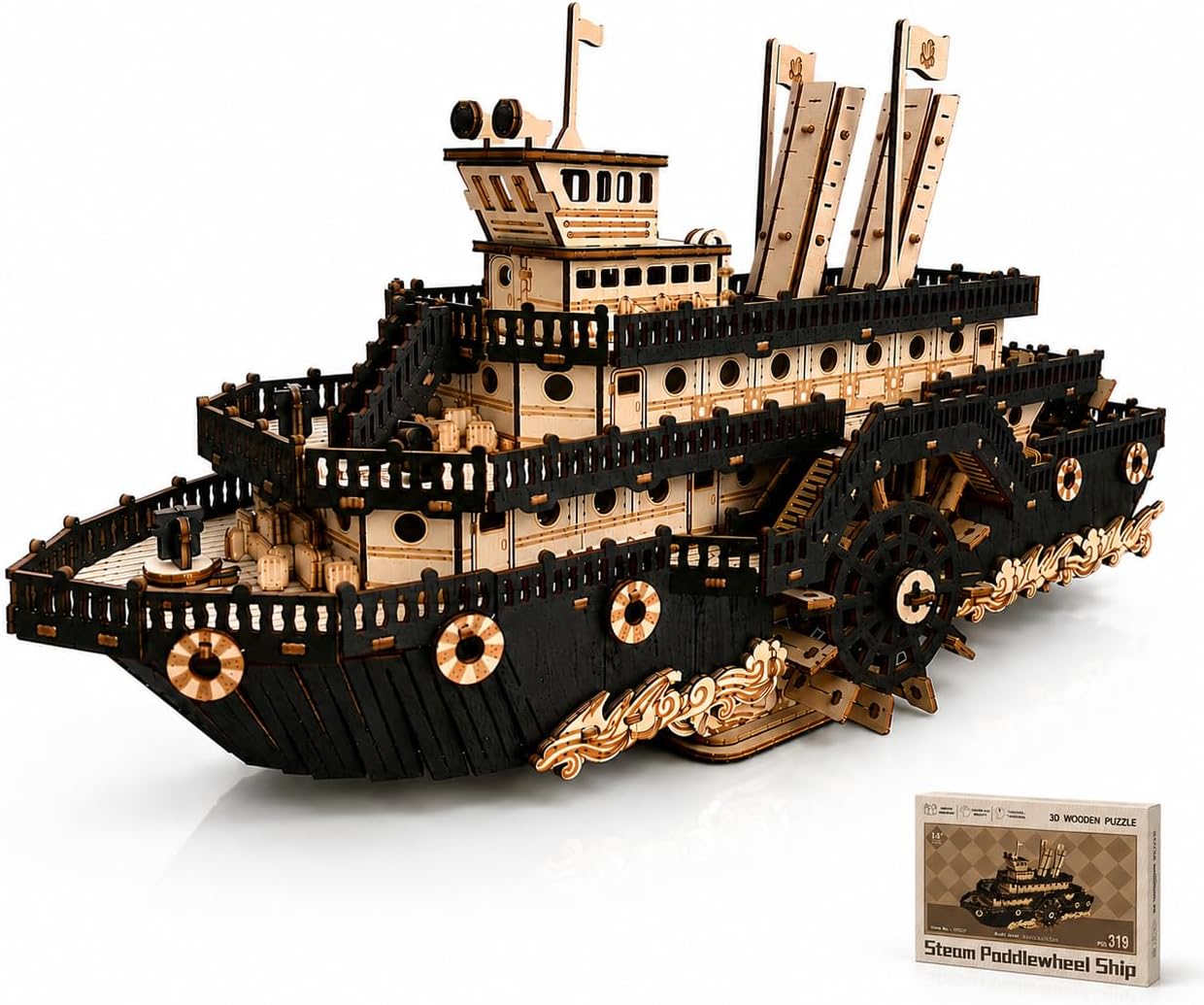
Many 3D wooden puzzles do not need glue because laser-cut tabs and slots form press-fit connections. Use adhesive only when the product instructions require it, when a decorative part has no mechanical connection, or when repairing a damaged joint. Keep gears, axles and other moving surfaces glue-free unless the manual explicitly says otherwise.
The safest rule is simple: build the joint as designed first. Glue should solve a specific problem, not replace checking the part number, direction and fit.
Why can a wooden puzzle stay together without glue?
A press-fit connection uses controlled friction. A wooden tab compresses slightly as it enters a matching slot, and the surrounding material holds it in place. Other walls, braces and layers then reinforce that connection as the model grows.
This system has three advantages:
- parts can be aligned before the model is complete;
- a mistaken orientation can sometimes be corrected;
- mechanical sections can remain free to move.
A joint may feel firmer after neighboring pieces are installed. That is why a slightly loose connection at one step does not always mean it needs adhesive immediately.
When should you use glue on a 3D wooden puzzle?
| Situation | Recommended approach | Why |
|---|---|---|
| Normal tab-and-slot joint | Dry-fit first; usually no glue | Preserves the intended press fit |
| Gear, axle or rotating section | Do not glue moving surfaces | Adhesive can stop movement |
| Loose decorative detail | Use a tiny amount only if allowed | Secures a non-structural part |
| Cleanly broken tab | Repair, align and cure before continuing | Restores strength before the joint is loaded |
| Reversed or uncertain part | Disassemble and check the manual | Glue makes correction harder |
| LED wire or contact | Follow the kit's routing method | Adhesive can damage or obstruct electrical parts |
The instructions supplied with the model take priority over general advice. Different kits can use different materials, finishes and joint designs.
How can you tell whether a kit is glue-free?
Read the product description and the opening pages of the instruction manual. Look for phrases such as “no glue required,” a list of supplied materials, or symbols that identify adhesive points.
The Paddle Steamer mechanical wooden model is described as a glue-free build. Its manual axle and paddle wheels depend on connected parts remaining free to rotate. A miniature house may use press-fit structural panels while treating a very small decorative accessory differently, so check the exact step rather than assuming one rule covers every part.
What should you do when a joint is loose?
First verify the part number and orientation. Make sure the tab is fully seated and no wooden debris remains in the slot. Look ahead to see whether another wall or brace will lock the connection.
If the joint remains loose:
- hold the parts in their final position and confirm the model stays square;
- test with a very thin removable paper shim if you need to understand the gap;
- remove the shim and use only the smallest amount of suitable adhesive if the instructions allow a permanent repair;
- keep the joint still until it has cured fully.
Do not fill a gap with a large bead of glue. Excess adhesive can squeeze onto printed surfaces, block the next slot or make the model sit unevenly.
What glue can be used for a wooden puzzle repair?
A precise craft or wood adhesive that is suitable for the model's material is generally easier to control than a large amount of fast-setting glue. The correct choice depends on the finish, the size of the break and the manufacturer's directions.
Apply adhesive with a toothpick or fine applicator. Protect the surrounding surface, ventilate the room and follow the adhesive label. Fast-setting products leave little time to correct alignment and can create visible marks, so they require particular care.
Can you glue a mechanical wooden puzzle?
Do not glue an axle, gear tooth, bearing surface or rotating contact point. Adhesive in these areas can make the finished mechanism rigid. If a stationary frame joint needs repair, isolate it from the moving system and allow it to cure before testing the mechanism.
Rotate the parts slowly after each surrounding section is installed. When resistance appears, inspect the most recent step instead of adding force.
How do you prevent tabs from breaking?
- Press near the joint rather than pushing from the far end of a panel.
- Check the printed face and part number before applying pressure.
- Remove small wooden cutouts completely from each slot.
- Lightly smooth a verified tight tab instead of forcing it.
- Support long beams, narrow rails and roof edges with two hands.
- Stop when tired; reversed parts are more common when attention drops.
If you are preparing for a first model, read the step-by-step building guide before opening the sheets.
If you plan to change the model's color, read what to check before painting a 3D wooden puzzle. Paint can affect a close-fitting joint just as excess adhesive can.
Frequently asked questions
Will glue make every wooden puzzle stronger?
No. Properly fitted interlocking pieces reinforce one another. Glue can interfere with alignment, correction and moving mechanisms when it is used unnecessarily.
Can I use super glue on a 3D wooden puzzle?
Only for a suitable repair and with care. It can mark surfaces, set before alignment and make moving joints rigid. Follow both the kit instructions and the adhesive label.
Should I glue an LED wire in place?
Use only the routing or securing method specified by the kit. Keep adhesive away from exposed contacts and test the light before enclosing the wire.
What if a tab is too loose but not broken?
Check whether a later brace secures it. If it remains loose, use a minimal repair method permitted by the instructions rather than coating the entire joint.
Can I take apart a glued wooden puzzle?
Some adhesives make disassembly difficult or impossible without damaging the wood. This is another reason to confirm orientation and dry-fit before applying glue.