
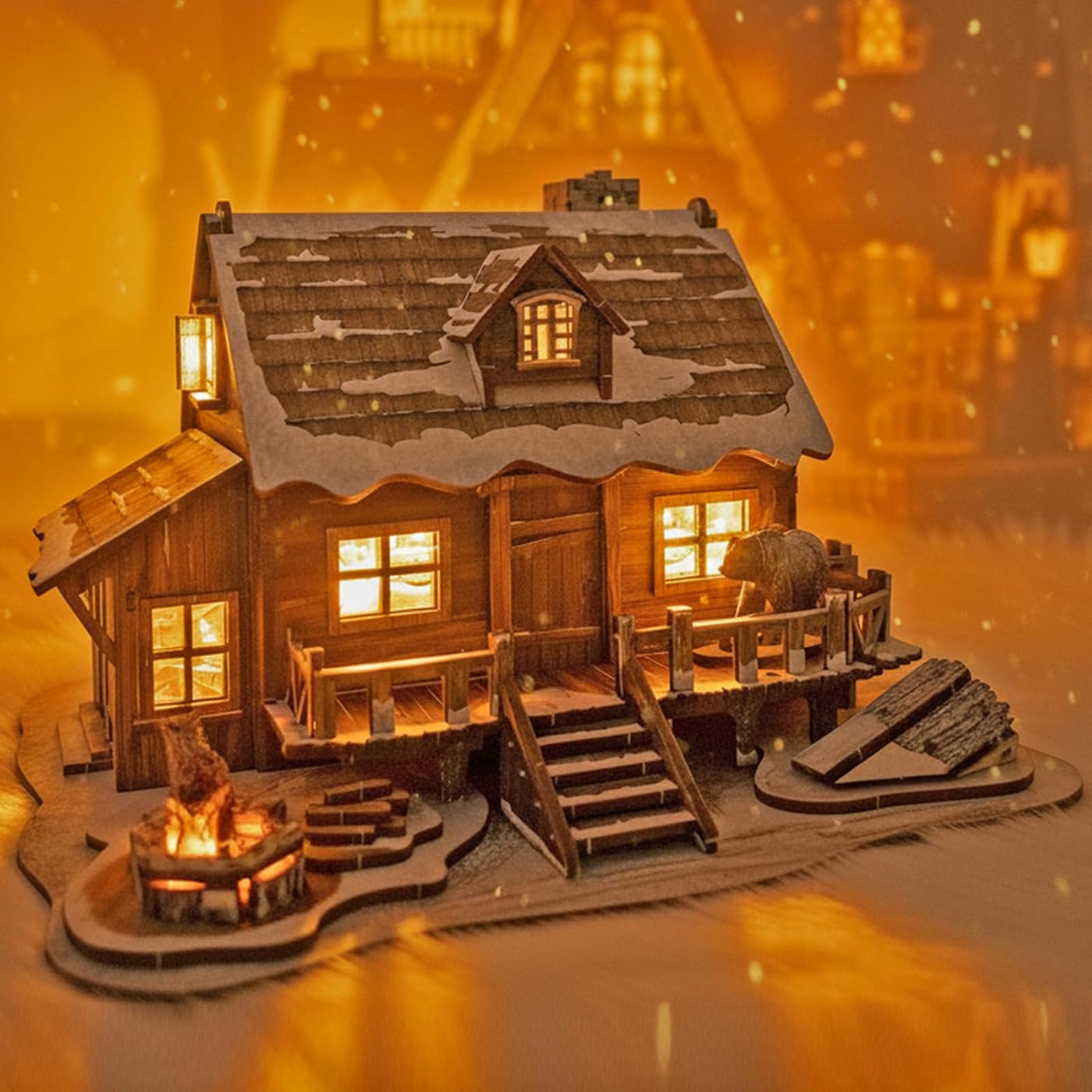
The honest answer is that a 3D wooden puzzle can take one focused evening, several relaxed sessions, or a full weekend. Piece count matters, but it is only one part of the estimate. A model with repeated architectural sections may feel steady and predictable, while a smaller model with lighting, layered scenery or moving parts may ask for more checking at each step.
The best way to choose is to think about the experience you want. Are you looking for a short creative break, a project to revisit over several evenings, or a substantial centerpiece that rewards a slower pace? Once you answer that question, the product’s piece count and features become much more useful.
How long does a 3D wooden puzzle take?
There is no universal minutes-per-piece formula. Builders work at different speeds, and the same person may build more slowly when a model has small decorative parts, electrical connections or a mechanism that needs careful alignment.
For one verified reference point, the Winter Cabin 3D wooden puzzle contains 198 pieces and its product information describes a 2–5 hour assembly. That range is more useful than a single promise because it allows for experience, breaks and the care taken with details.
Other Astshun&co models illustrate why piece count should remain a guide rather than a timer:
| Model | Listed pieces | Feature that can affect the pace |
|---|---|---|
| Hawaiian Beach House | 187 | Miniature scenery and LED lighting |
| Winter Cabin | 198 | Opening roof, interior details and LED lighting |
| Beach House | 244 | Layered coastal details and lighting |
| Paddle Steamer | 319 | Manual axle and moving paddle wheels |
| Fantasy Castle | 433 | Rotating section and multicolor lighting |
| Big Ben Clock Tower | 595 | Repeated architectural detail and a tall structure |
This comparison does not assign an exact completion time to every model. It shows what to inspect before planning your sessions.
What affects wooden puzzle build time?
Piece count and repetition
More pieces usually mean more individual connections. Repeated windows, walls or structural layers can create a comfortable rhythm, though. Once you understand the pattern, later sections may progress more quickly than the first.
Part size and orientation
Small parts take longer to identify and position. Symmetrical pieces may look interchangeable at first, so checking their labels and orientation before pressing them into place can prevent time-consuming corrections.
Lighting and moving features
An LED model asks you to route or connect its lighting components as described in the supplied instructions. A mechanical model requires connected parts to move together. These features add interest to the finished result, but they also reward a slower test-and-check approach.
Your building style
Some builders sort every sheet and tool before starting. Others identify parts as they reach each step. Some prefer one uninterrupted session; others enjoy stopping after each major section. None of these approaches is wrong. Your preferred pace is part of the project.
Breaks and corrections
A completion estimate usually describes active assembly time. It may not include time spent arranging the workspace, taking breaks, photographing progress or carefully reversing a connection. Leaving room for those moments makes the experience more enjoyable.
How to choose a puzzle for the time you have
If you have one free evening, begin with a lower piece count and a subject you immediately understand. A house model can be especially approachable because walls, roofs and rooms provide visible milestones. The Hawaiian Beach House guide explains how its 187 pieces become a tropical miniature scene.
For a project spread across several evenings, consider a mid-size model with a feature you can look forward to testing. The 319-piece Paddle Steamer adds manual paddle-wheel movement, while the Beach House uses lighting and coastal scenery to build toward a decorative result.
If you want a longer, absorbing project, a high piece count or layered architecture can provide it. The 595-piece Big Ben 3D wooden puzzle is designed around recognizable landmark details. The Fantasy Castle combines 433 pieces with movement and light.
Browse the complete 3D wooden puzzles for adults collection to compare confirmed piece counts and features in one place.
How to plan a relaxed building session
- Read the next few instruction steps before removing parts. Knowing what a group of pieces will become makes their orientation easier to understand.
- Use a clean, well-lit surface. Give yourself room for the instruction booklet, unassembled sheets and completed sections.
- Sort only as much as the instructions require. Over-sorting can take time without helping. Keep the current pieces separate and leave later sheets intact.
- Stop at a natural milestone. A finished wall, floor or mechanism is easier to protect between sessions than several loose parts.
- Test special features before closing the structure. Follow the kit instructions for lighting or movement and confirm the relevant connections while they remain accessible.
- Protect the work in progress. If you need the table for something else, move the model on a rigid board rather than carrying partially connected sections by hand.
Building time is not a score. A careful five-hour build is not less successful than a fast two-hour build. The goal is to understand the structure, enjoy the sequence and finish with a model you are pleased to display.
Frequently asked questions
Can I finish a 3D wooden puzzle in one day?
Some models can fit into a day, especially when the listed piece count is lower and the builder has an uninterrupted workspace. More detailed, illuminated or mechanical kits may be more comfortable across several sessions.
Does a higher piece count always mean a harder puzzle?
No. Piece count affects the amount of assembly, but part size, repeated patterns, lighting and moving mechanisms also influence the challenge and pace.
How long does the Winter Cabin wooden puzzle take?
The verified product information describes a 2–5 hour assembly for its 198 pieces. Individual time can vary with experience and building style.
Should a beginner choose the fewest pieces?
Piece count is a useful starting point, but a beginner should also compare the instructions, part size and special features. Our beginner’s difficulty guide explains these factors.
Is it okay to build a wooden puzzle over several days?
Yes. Stop at a stable stage, keep loose pieces organized and protect the work from pets, moisture and accidental movement between sessions.