
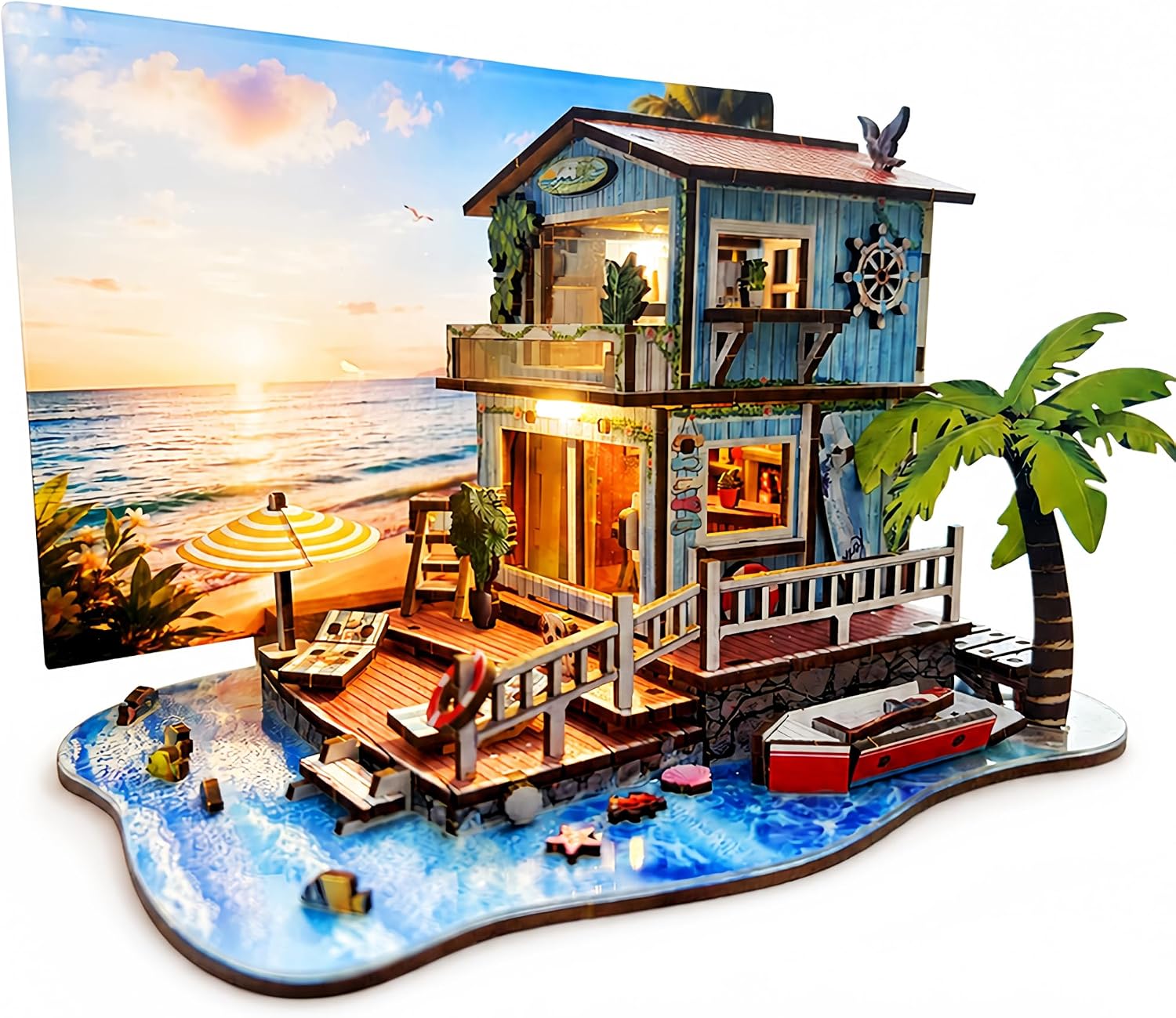
To move a finished 3D wooden puzzle, support its entire base, remove or secure loose accessories, and keep pressure away from roofs, railings, towers and moving parts. For a trip beyond the room, place the model upright in a rigid box with padding that stops the *base* from sliding without pressing on decorative details. Switch off the lights and follow the kit's instructions for any removable power component. These steps reduce avoidable damage, but no packing method guarantees that a delicate assembled model will survive a long journey or shipment.
This guide is for an adult moving a completed model between rooms, homes or display spaces. If the model is still partly assembled, first read our step-by-step building guide on pausing a build safely. If you are deciding where it will live after the move, our broader display and care guide covers shelf clearance, dust, light and moisture.
What should you do before lifting the model?
Clear the destination first. Make space on a level surface, measure its available width, depth and height, and check that you can reach it without opening a door against the model. If the destination is a box, open it fully and prepare its support before picking the puzzle up. A move is most awkward when one hand holds a miniature and the other tries to rearrange a shelf.
Inspect the model from all sides. Look for a decorative piece that is loose, a roof that can open, a detachable backdrop, an exposed cable or a mechanism that can move unexpectedly. Take a few photographs so you know how the details were arranged. Place truly detachable accessories in a small labeled container rather than trying to wedge them into place with tape. Do not pull off a fitted part just because it looks removable; consult the model's instructions first.
Switch off or disconnect power as the kit directs. Keep cables from catching a handle or shelf edge. If there is a battery compartment, follow the product's transport guidance. The LED troubleshooting guide can help with checks after the move.
Rolife's guidance for moving finished miniature houses similarly recommends checking loose parts first, supporting the base and keeping pressure off decorative sections. Those are general handling principles; the exact Astshun&co kit manual still governs detachable pieces and power components.
How do you carry a completed wooden puzzle across a room?
Use two hands beneath the main structural base and keep the model level. If the base is too wide or an irregular shape makes it hard to grip, slide a rigid, flat board under the full footprint while the model is still on a stable surface. Lift the board, not an upper wall or a decorative feature. A shallow tray with a low edge can also help keep a model from shifting during a short move, provided it supports the whole base and does not contact fragile details.
Walk the route before lifting. Remove obstacles and carry one model at a time. Grasping a tower at its middle puts leverage on windows and layered walls. For a wide model, ask another person to clear the route rather than changing your grip mid-walk.
Set the board or base down fully before letting go. Check that all feet have support and no wire is trapped underneath. Then restore any detachable decoration or lighting according to the instructions. Rolife's display and storage guide also favors a clear route and two-handed support.
How should you pack a finished 3D wooden puzzle for a longer trip?
Choose a rigid container larger than the model's *widest and tallest* points. Measure from any extended deck, backdrop, railing or roof feature, not only the central building. Leave a gap around the delicate silhouette so the box cannot press directly on it. The old retail box may be designed for flat, unassembled sheets rather than a completed three-dimensional object; measure it before reusing it.
Build a stable platform in the bottom of the box. The goal is to stop the model's base from sliding while leaving upper details untouched. Place clean, dry, non-abrasive padding around the *base or supporting board* and fill the surrounding void without pushing material into windows, stairs, wheels or foliage. Close the lid gently to check clearance; the lid should not touch the model. Do not stack another box on top of one containing an assembled miniature.
| Before the box closes | Why it matters |
|---|---|
| Model stands upright on full-base support | Narrow contact points can tilt or concentrate pressure |
| Loose accessories are labeled separately | Small parts can shift or become hard to identify |
| Padding restrains the base, not delicate details | A snug box can still crush railings or roof edges |
| Power cable is protected from pulling or pinching | A trapped lead can damage a connection |
| Lid and sides have clearance | The outer box may flex during handling |
Mark which side is up and keep the box where it cannot tip or receive a heavy load. In your own vehicle, place it on a stable surface, not at the bottom of a pile. Carrier shipping introduces handling you cannot control. Check the carrier's requirements and consider specialist packaging for a fragile or irreplaceable piece.
Which Astshun&co models need different handling checks?
The general rule is the same—support the base—but the fragile or movable feature changes by model. Use the current product page and manual to identify what can actually detach.
The Winter Cabin has an opening roof and warm LED lighting. Before moving it, check that the roof is in a stable position and that lighting components are not caught under the base. Avoid placing padding against its snowy roof or small exterior details. The Hawaiian Beach House includes palm trees, furniture details and an acrylic greeting card that can serve as a backdrop; consider whether the card can be stored separately without disturbing the house.
The Seaside Cabin with Acrylic Backdrop is a two-level waterfront scene with stairs, a boat and a separate scenic panel. Its listed assembled size is approximately 7.80 × 5.91 × 4.92 inches. Measure the complete arrangement, including the panel if displayed behind it, before choosing a box. Its lighting is USB-powered, so protect and later inspect the connection. The Fantasy Castle has a rotating side section, while the Paddle Steamer has a manual axle and paddle wheels. Do not use either moving feature as a handle or lock it with improvised glue or tape.
The Big Ben Clock Tower is listed at 20.2 inches tall when assembled, so vertical clearance matters more than it does for a low house. A high, narrow model can tip if its base is not restrained. The wooden soccer ball puzzles rest on display stands; keep the sculpture and stand together as identified components, and do not treat the finished ball as sports equipment during a move.
What should you check after unpacking?
Place the model on a level surface before removing protective material around its base. Compare it with your pre-move photographs. Look for a displaced roof, loose decoration, shifted backdrop or part caught under the model. Reattach only pieces you can identify and place according to the instructions. If a structural piece has cracked, stop before operating any moving section; our broken-piece guide explains how to assess the damage.
Inspect lighting and power connections before switching on. Do not force a bent connector. Test only as directed by the manual, then choose a display position with enough depth and clearance. The completed object holds the builder's time and choices; an unhurried move helps that small world reach its next shelf intact.
Frequently asked questions
Can I carry a finished 3D wooden puzzle by its roof?
No. Support the main base or a rigid board beneath it. Roofs, towers, railings and other upper features may be decorative or movable rather than load-bearing.
Should I use the original product box for an assembled model?
Only if it has enough room for the *assembled* footprint and allows padding around the base without contacting delicate parts. Many kit boxes are sized for flat sheets, so measure first.
Can I wrap the whole model tightly in bubble wrap?
Tight wrapping can press on small details. Protect the base and use a rigid outer container with clearance around the silhouette. If a particular model includes a protective case or packing instructions, follow those instead.
What if a part comes loose during the move?
Keep it in a labeled container and compare it with the instructions and pre-move photos before reattaching it. Do not force it into a likely-looking slot or cover a structural problem with paint.
Is this packing method safe for mailing a completed puzzle?
It is a practical starting point for a careful move under your control, not a guarantee for carrier shipping. Check the carrier's rules and seek specialist packaging when the assembled model is fragile, valuable or difficult to replace.