
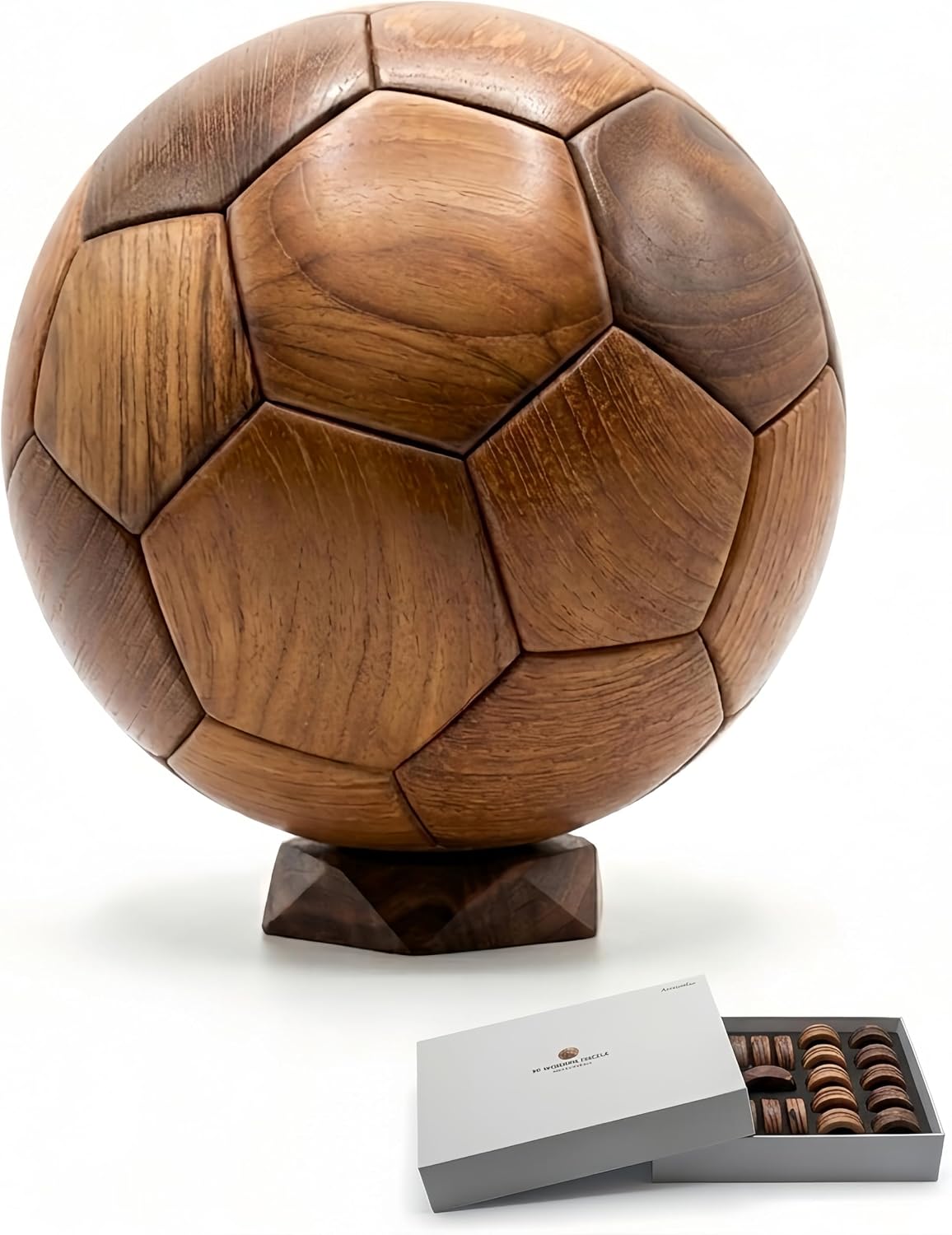
A wooden soccer ball puzzle for adults turns 32 solid-wood polygonal pieces into a life-size football sculpture. The finished object rests on a geometric stand and is intended for display, making it different from both a flat sports puzzle and a playable soccer ball.
Astshun&co offers two versions: walnut with teak and walnut with beech. Their construction concept is the same. The main choice is visual: warm golden contrast or a lighter, sharper contrast.
How does a wooden soccer ball puzzle work?
A soccer ball surface is built from pentagonal and hexagonal sections. In these wooden models, the familiar geometry becomes an interlocking three-dimensional assembly.
The pieces use mortise-and-tenon connections and assemble without glue or nails. Each connection contributes to the strength of the full sphere, so orientation matters even though the kit contains only 32 pieces.
Fewer pieces do not automatically mean an effortless build. A house can grow from a flat base, while a ball must close into a continuous curved form. The later pieces interact with several surrounding sections at once, making sequence and alignment especially important.
Walnut and teak vs. walnut and beech
| Feature | Walnut & Teak Soccer Ball | Walnut & Beech Soccer Ball |
|---|---|---|
| Piece count | 32 solid-wood pieces | 32 solid-wood pieces |
| Construction | Glue-free mortise-and-tenon assembly | Glue-free mortise-and-tenon assembly |
| Finished form | Life-size soccer ball sculpture | Life-size soccer ball sculpture |
| Display | Geometric stand included | Geometric stand included |
| Visual character | Dark walnut with warm golden teak | Dark walnut with pale beech |
Choose walnut and teak for a warmer, richer palette. Teak brings golden-brown color next to dark walnut, giving the ball a more blended and traditional wood tone.
Choose walnut and beech for stronger light-and-dark contrast. Pale beech makes the panel pattern easier to read from a distance and can suit a brighter room or modern shelf.
Because natural wood grain varies, every finished surface will have small visual differences. That variation is part of the material rather than a printed effect.
Is a 32-piece soccer puzzle challenging?
It can be. The challenge comes from spatial reasoning and interlocking geometry rather than from sorting hundreds of parts. A builder needs to understand which edge meets the next piece and how the forming sphere should be supported.
Work on a clean table with enough room to rotate the assembly. Follow the specified sequence and avoid forcing a connection that is not aligned. As the ball closes, support the existing structure with both hands rather than pressing against a single panel.
The completed model has substantial solid-wood construction. Place it directly on its included stand after assembly so it cannot roll from the table.
For a closer look at each version, read the walnut-and-teak model guide and the walnut-and-beech 32-piece guide.
Is this wooden football intended for play?
No. The finished ball is a sculpture and display puzzle. It should not be kicked, thrown or used as sports equipment.
That distinction matters when choosing the product as a gift. Its appeal is the building experience, natural wood and familiar football geometry. It belongs on a desk, shelf, cabinet or sports memorabilia display after completion.
Use the geometric stand, keep the model indoors and avoid moisture or direct heat. To remove dust, use a soft dry brush. Do not clean the surface with water.
Who would enjoy a wooden soccer ball puzzle?
This puzzle can suit:
- adult soccer and football fans;
- players or coaches marking a season or milestone;
- collectors of sports memorabilia;
- woodworkers interested in traditional joinery;
- puzzle builders who prefer geometry to miniature architecture;
- gift recipients who already have shirts, balls and conventional team merchandise.
It also offers a different route into the larger category of 3D wooden puzzles for adults. Someone who is not interested in miniature houses may still enjoy constructing a recognizable sports object.
How should you choose between the two wood combinations?
Start with the room where the model will be displayed. Dark shelves often benefit from the brighter contrast of beech. Light shelves may make the deeper teak-and-walnut palette stand out more clearly.
Then consider the recipient’s taste. Warm teak feels classic and understated. Pale beech makes the soccer pattern more graphic. Both versions use the same 32-piece, life-size concept and include a stand, so there is no need to choose by piece count.
Finally, check current availability and product details. The individual product pages link to the official Amazon listings for price, stock, delivery and return information.
Frequently asked questions
What is a soccer puzzle ball?
It is a three-dimensional puzzle that forms a soccer ball shape. The Astshun&co versions use 32 interlocking solid-wood polygonal pieces to create a life-size display sculpture.
Does the wooden soccer ball need glue?
No. The two models compared here use mortise-and-tenon assembly without glue or nails.
Can you kick the completed wooden soccer ball?
No. It is an adult building puzzle and display object, not playable sports equipment.
Does a display stand come with the puzzle?
Yes. Both the walnut-and-teak and walnut-and-beech versions include a geometric stand for the finished ball.
Which wood combination should I choose?
Choose walnut and teak for warm golden contrast or walnut and beech for a brighter light-and-dark pattern. The construction and finished life-size format are otherwise similar.