
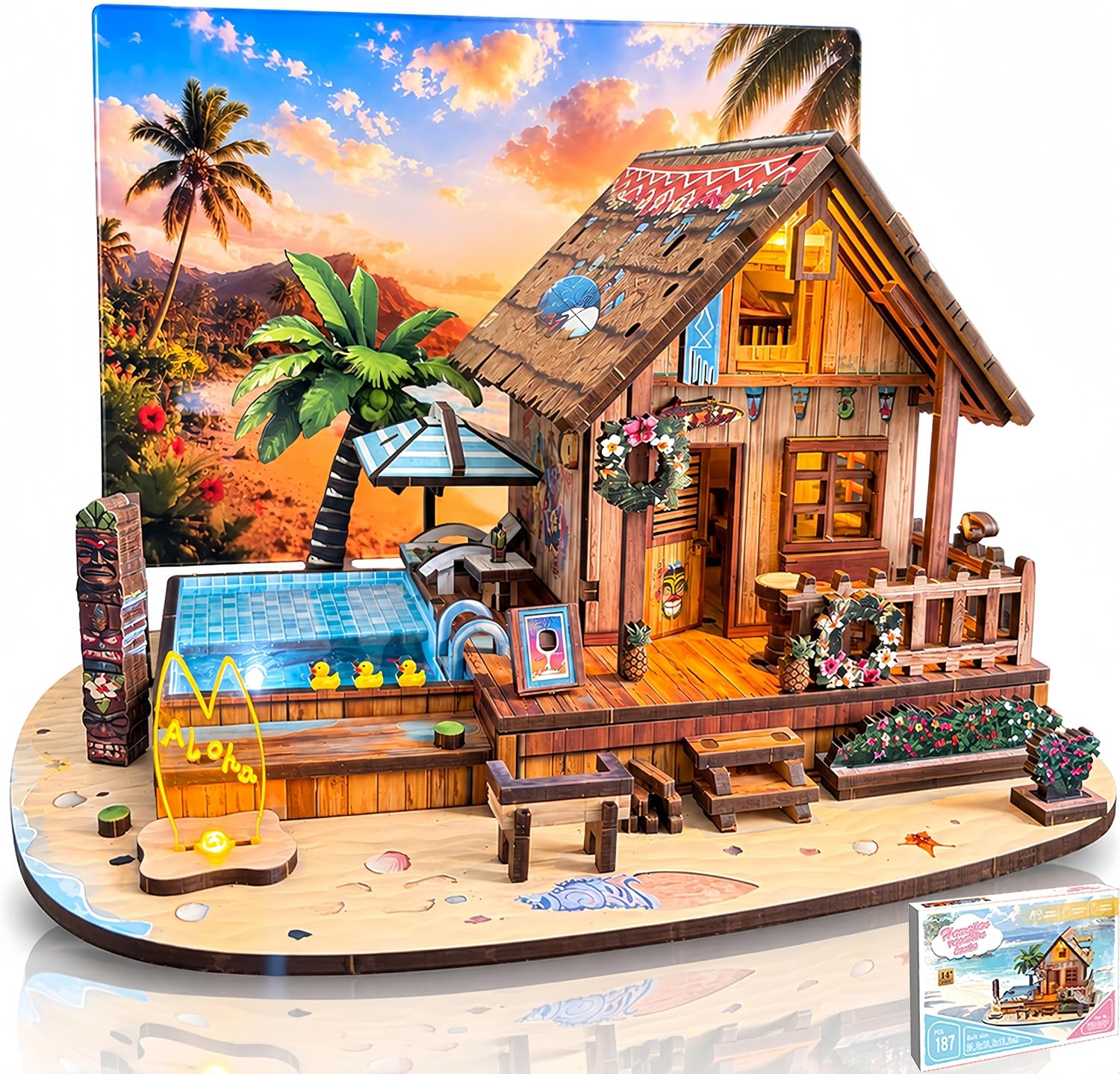
The best 3D wooden puzzle for a beginner has clear instructions, a manageable number of pieces, visible connection points and a finished design the builder actually wants to display. For most first-time adult builders, a stationary model with roughly 150 to 300 pieces is a comfortable starting range. It provides a real project without adding the extra alignment demands of gears or complex moving mechanisms.
Piece count is only one part of difficulty. Tiny decorative parts, repeated architectural sections, hidden wiring and moving assemblies can make a lower-piece kit more demanding than a larger but straightforward house model.
What makes a 3D wooden puzzle good for beginners?
A beginner-friendly wooden puzzle should make progress easy to understand. Numbered sheets, step-by-step diagrams and parts that can be identified without guesswork are more useful than an unusually low piece count.
Good first-kit features include:
- a stationary structure rather than a gear-driven mechanism;
- medium-size parts with clearly shaped tabs and slots;
- an estimated build time that fits two or three relaxed sessions;
- a stable base so completed sections do not shift while you work;
- lighting that can be tested before the model is closed;
- a subject you would enjoy seeing on a shelf after assembly.
The finished design matters because interest helps carry a builder through repetitive steps. Someone who likes cozy interiors may enjoy a miniature house. An architecture fan may prefer a landmark. A mechanically curious builder may accept a steeper first project because the moving result is the main attraction.
How many pieces should a beginner choose?
For many adults, 150 to 300 pieces is a useful first range. It is large enough to teach sheet organization, tab fitting and three-dimensional alignment, while still making progress visible in each session. This is a practical guideline rather than a rule.
| Approximate piece count | What to expect | Good fit for |
|---|---|---|
| Under 150 | Shorter project with larger milestones | A casual first try or limited build time |
| 150–300 | Balanced introduction to assembly and detail | Most adult beginners |
| 300–500 | Longer build with more repeated or decorative work | Patient beginners and experienced crafters |
| 500+ | Multi-session project with many alignment checks | Builders who already enjoy detailed model work |
Compare piece count with estimated time and model type. A 244-piece illuminated house can feel methodical, while a 319-piece mechanical ship asks the builder to monitor moving parts and friction. Our guide to 3D wooden puzzle build times explains why those numbers do not always rise together.
Which model style is best for a first build?
Miniature houses are approachable because walls, floors and roofs create recognizable stages. The Hawaiian Beach House uses 187 pieces and warm lighting, while the Winter Cabin uses 198 pieces and an opening roof. Both give the builder clear visual milestones.
Architectural landmarks suit beginners who enjoy symmetry and repeated details. They may have more pieces, so they reward careful organization. The Big Ben model is better treated as a longer first project than a quick weekend build.
Mechanical models add motion, axles or gears. Correct alignment affects how the final mechanism works. Choose one first only if functional construction is what excites you most.
Sculptural puzzles use shape and geometry rather than rooms or machinery. They can have fewer pieces yet still require close attention to orientation.
What tools do you need for your first kit?
Many press-fit wooden kits need no special tools. A clean table, small containers and good lighting are the essentials. A craft knife or small file, fine sandpaper, tweezers and a white towel for keeping tiny pieces visible can make the work easier.
Do not assume every joint needs glue. Dry-fit the pieces and follow the kit instructions first. Read Do 3D wooden puzzles need glue? before adding adhesive to a moving or removable section.
A simple first-build checklist
- Match every sheet and accessory bag to the parts list.
- Read several instruction steps ahead before removing pieces.
- Press near a tab when releasing a part from its sheet.
- Sand only the edge that is actually catching.
- Dry-fit each connection and confirm orientation before pressing.
- Build on a flat surface and keep completed sections supported.
- Test LED components before wires become enclosed.
- Stop when tired; rushed force causes more damage than slow assembly.
For a complete sequence, follow our step-by-step building guide. The goal of a first kit is not speed. It is learning how the material behaves and finishing a model you are pleased to keep.
Frequently asked questions
What is the easiest type of 3D wooden puzzle for an adult beginner?
A stationary miniature house or simple architectural model is often easiest because its floors, walls and roof form recognizable stages. Clear instructions and medium-size parts matter more than choosing the lowest possible piece count.
Is a 200-piece 3D wooden puzzle difficult?
A 200-piece kit is usually manageable for a patient beginner. Difficulty still depends on part size, wiring, repeated details and whether the model contains moving mechanisms.
How long should a first 3D wooden puzzle take?
Many beginner-friendly kits take several hours spread across one or more sessions. Use the maker’s estimate as a planning guide and allow extra time for organizing, checking orientation and testing lights.
Should a beginner choose a puzzle with LED lights?
Yes, if the instructions show when to route and test the wiring. LED lighting adds a few careful steps, but it also gives the finished model a strong display effect.
Can adults build 3D wooden puzzles without previous model-making experience?
Yes. Start with a clear, stationary design, work in numbered order and avoid forcing tight joints. Previous craft experience helps, but careful pacing is more important.