
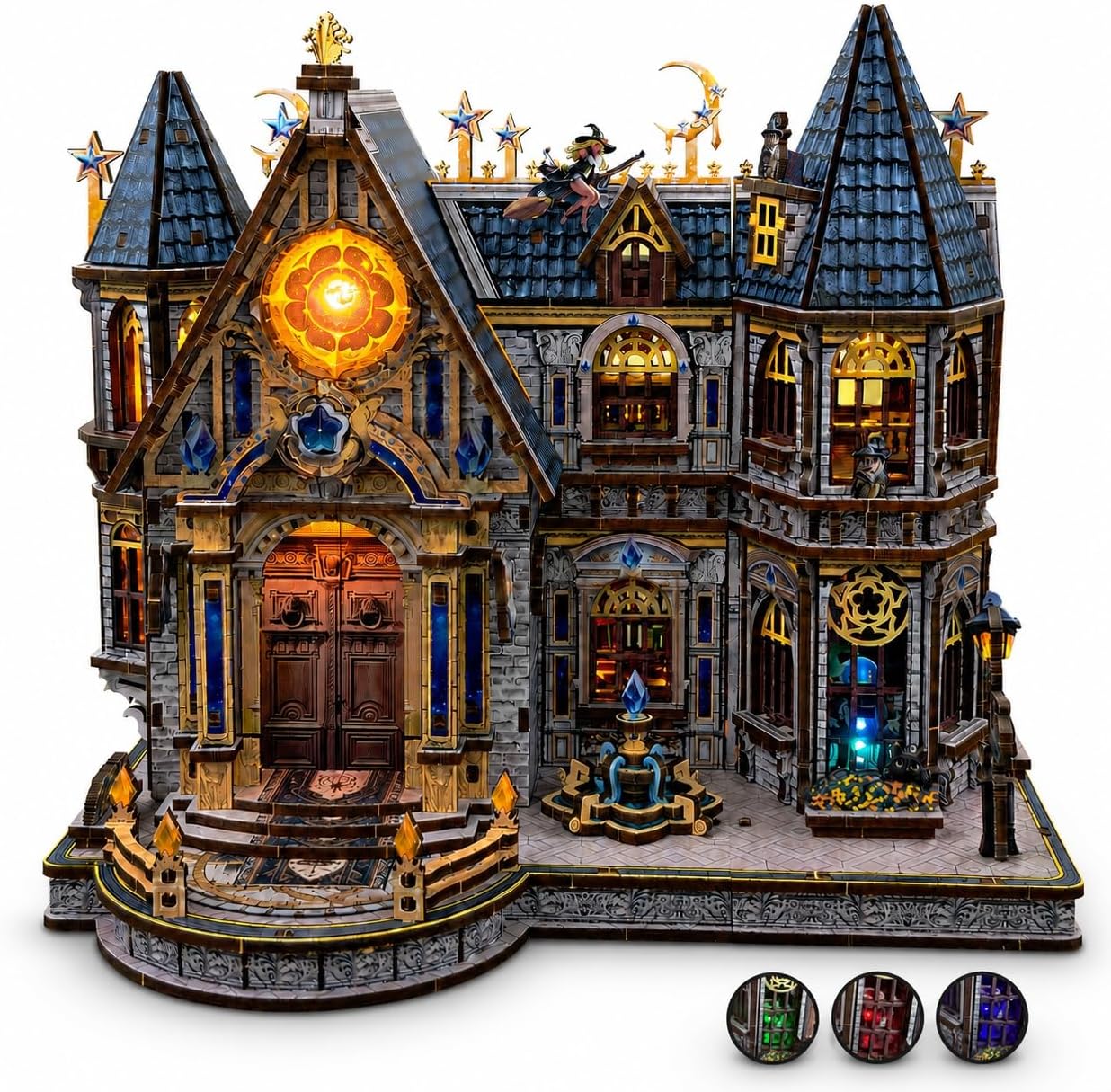
Finishing a 3D wooden puzzle changes it from a project into an object with a story. The model holds the time spent identifying parts, solving small problems and watching a flat set of pieces become a miniature place, landmark or machine. A thoughtful display lets you enjoy that work while protecting the wood and small details.
Good care is simple: support the model on a stable surface, limit dust, avoid prolonged direct sunlight and keep it away from damp areas. The best location also suits the character of the model, whether that means viewing an illuminated interior after dark or seeing a mechanical feature from the side.
Where should you display a 3D wooden puzzle?
Choose a level shelf, desk, cabinet or side table that is deeper than the model’s base. All supporting feet or edges should sit fully on the surface. Avoid narrow ledges where a sleeve, curtain or opening door can catch the model.
Before choosing the location, check four things:
- Stability: the furniture should not wobble when a drawer or nearby door opens.
- Clearance: leave room above and around the model for tall sections, openable roofs or moving parts.
- Viewing angle: place the most detailed side where people can see it without frequently handling the model.
- Access: illuminated or interactive features should remain reachable according to the product instructions.
An acrylic display case can reduce dust and accidental contact when a model has many exposed details. Measure the completed model at its widest and tallest points, then allow extra clearance so the case never presses against railings, roofs or mechanisms.
How to keep a wooden model clean
Regular light dusting is safer than waiting for a heavy layer to build up. Use a clean, dry, soft brush to move dust away from roofs, windows and decorative parts. A small artist’s brush can reach corners without forcing a cloth between fragile details.
Support the base with one hand when cleaning. Work from the top downward so loose dust falls away from areas you have already finished. Do not lift a model by a tower, roof, railing or rotating section.
Avoid soaking the wood or spraying cleaner directly onto the model. Liquid can enter joints, affect finishes or reach electrical components. If the specific product instructions provide cleaning directions, follow those directions first.
For a model inside a case, dust the case exterior regularly and clean its interior only after removing the model to a safe, flat surface. Let the case dry completely before returning the wooden puzzle.
Light, moisture and temperature
Limit prolonged direct sunlight
Strong sunlight can warm a display area and may change the appearance of wood or printed surfaces over time. A bright room is fine, but choose indirect light rather than a place where the model receives hours of direct sun through a window.
Keep the model dry
Wood responds to moisture. Avoid bathrooms, damp basements, areas beside a humidifier and shelves directly above a sink. If the room regularly feels damp, a more stable indoor space is a better choice.
Avoid heat sources
Do not place a wooden model against a radiator, heater, fireplace or hot appliance. Repeated heating and cooling can be hard on both wooden connections and electrical components.
Protect lighting components
For illuminated models, operate and store the lighting system as directed by the kit instructions. Keep the relevant switch or connection accessible, and inspect the model before use if it has been stored for a long period.
Display ideas for different models
Illuminated miniature houses
LED houses benefit from a location that can be seen in both daylight and evening light. A shelf at or slightly below eye level reveals the roof, rooms and landscape together. The Winter Cabin has an opening roof, so it needs extra space above the model. The Seaside Cabin uses an acrylic ocean backdrop that is best viewed without visual clutter immediately behind it.
Architectural landmarks
Tall models need vertical clearance and a stable base. The 595-piece Big Ben Clock Tower can act as a vertical focal point on a bookshelf or cabinet. Leave space around the silhouette so the architecture remains easy to read.
Fantasy displays
The Fantasy Castle combines multicolor light with a rotating section. Place it where the feature can be reached without moving the entire model and where nearby objects will not block the rotating area.
Mechanical models
A moving wooden model is easiest to appreciate when its mechanism can be seen from the correct side. The Paddle Steamer uses a manual axle to move the paddle wheels, so provide enough side clearance for operation and viewing.
Wooden puzzle sculptures
The soccer ball models include display stands that support their round geometry. Keep the stand and sculpture together on a level surface, away from shelf edges. Their contrasting wood tones work especially well against a simple background.
If you are still selecting a model, compare the full 3D wooden puzzles for adults collection by finished style, piece count and special feature. Planning the display location before buying can help you choose a model that fits your home as well as your available building time.
Moving or storing a finished wooden puzzle
Before moving a model, remove any loose accessories and switch off lighting as directed. Support the entire base with both hands. For a longer move, place the model in a box larger than its widest point and use soft, non-abrasive padding around the base and open spaces. Padding should prevent sliding without pressing on fragile details.
Store the box in a dry, temperature-stable place. Label which side faces upward. If the model has removable or opening sections, secure them according to the product instructions rather than improvising an adhesive that could mark the finish.
A well-chosen display is part of the building experience. It gives the finished model room to be noticed and reduces the need to handle it. That makes it easier for the memory of the build to remain visible long after the final connection is made. To share that finished result, follow our guide to photographing a 3D wooden puzzle.
Frequently asked questions
How do I remove dust from a 3D wooden puzzle?
Use a clean, dry, soft brush and support the model at its base. Work gently from top to bottom and avoid pushing cloths between small decorative parts.
Can I clean a wooden model with water?
Avoid soaking the model or spraying liquid directly onto it. Water can reach joints, finishes or electrical parts. Follow any cleaning directions supplied with the specific kit.
Should I put my wooden puzzle in a display case?
A case is optional, but it can reduce dust and accidental contact. Choose one with clearance around every side so it does not touch roofs, railings or moving parts.
Can sunlight damage a wooden puzzle?
Prolonged direct sunlight can heat the model and may change the appearance of wood or printed surfaces over time. Indirect indoor light is a safer choice.
How should I move a finished 3D puzzle?
Lift it from the base with both hands, remove loose accessories and keep pressure away from tall or delicate parts. For longer transport, use a larger box with soft padding around the base.
For a full packing checklist and model-specific handling notes, read how to move a finished 3D wooden puzzle.